Peter V’landys is preparing to end his extraordinary 22-year reign as Racing NSW chief executive, leaving behind an organisation transformed by legal victories, unprecedented prize-money growth and the creation of races that permanently shifted Australian thoroughbred racing’s centre of power towards Sydney.
The 64-year-old is expected to leave Racing NSW after accepting an expanded position as the Australian Rugby League Commission’s first executive chairman.
His appointment is yet to be formally ratified, while Racing NSW has not confirmed the date or terms of his departure.
However, V’landys’ move into a permanent NRL executive position means his tenure as the most powerful administrator in Australian racing is approaching its conclusion.
Racenet has described V’landys as departing a winner after making NSW racing the envy of the world.
That assessment is understandable.

V’landys turned Racing NSW into a commercial powerhouse, created The Everest and successfully challenged wagering operators for revenue that now flows throughout Australian sport.
His legacy is nevertheless more complicated than an uncomplicated victory lap.
He strengthened NSW racing enormously, but also centralised considerable power, escalated interstate competition and left his eventual successor confronting significant governance questions.
The Court Victory Changed Australian Sport
V’landys’ most consequential achievement did not occur at Royal Randwick.
It occurred in the High Court.
Racing NSW introduced race-fields legislation requiring wagering operators to pay for using the state’s racing product.
Corporate bookmakers challenged the model, arguing the fees were invalid.
V’landys refused to retreat.
Racing NSW ultimately prevailed in the High Court in 2012, establishing the legitimacy of race-fields fees and unlocking revenue that could be reinvested through prize money, infrastructure, participant payments and integrity measures.
“In the High Court, I had the vibe,” V’landys later joked while reflecting upon the case, according to The Greek Herald.
“And we won.”
The reference to The Castle understated the seriousness of the contest.
Without that victory, Racing NSW could not have funded many of the initiatives that came to define the V’landys era.
The case also extended beyond thoroughbred racing. The legal principle strengthened the ability of sporting organisations to charge wagering companies for profiting from their events.
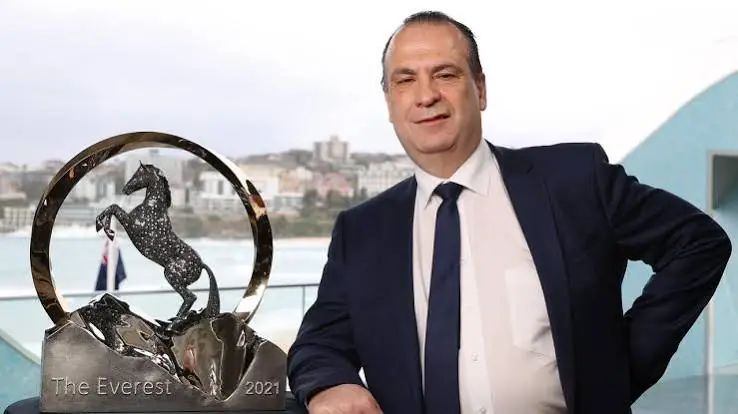
The Everest may be his most visible creation.
The High Court victory was arguably his most important.
The Everest Rebuilt Sydney’s Spring Carnival
V’landys understood that increased revenue alone would not make Sydney the centre of Australian racing.
NSW needed events capable of attracting younger audiences, international horses and national attention during a period traditionally dominated by Melbourne.
The Everest provided the answer.
Introduced as a $10 million slot race in 2017, the 1200-metre sprint initially faced criticism because it operated outside the established black-type system.
Traditionalists questioned whether enormous prize money could manufacture prestige.
The market delivered its answer remarkably quickly.
The inaugural Everest attracted 33,512 spectators to Randwick and was won by Redzel. Prize money subsequently increased to $20 million, while the race gained Group 1 status in 2024.
By 2025, more than 50,000 people attended Randwick to watch Ka Ying Rising win, with Racing NSW reporting that approximately 60 per cent of the crowd was aged under 26.
The race was televised into more than 200 countries and reportedly attracted more than $16 million through the international World Pool.
Those figures demonstrate why The Everest must be considered one of the great administrative successes in modern Australian sport.
It did not merely add another rich race to the calendar.
It gave Sydney a genuine spring racing identity.
The Sporting Base recently detailed how Ka Ying Rising has returned to Australia in improved condition before defending his Everest title, illustrating the international attraction V’landys helped create.
His Influence Extended Beyond One Race
Reducing the V’landys legacy to The Everest would ignore the breadth of Racing NSW’s expansion.
The Championships strengthened Sydney’s autumn carnival, while the Golden Eagle created a lucrative target specifically for four-year-olds.
The Kosciuszko gave country-trained horses access to a major Randwick stage and transformed the ambitions of regional trainers and owners.
The Big Dance established a metropolitan final for horses qualifying through country cup races.
Highway races, country showcase meetings and the Provincial-Midway Championships created pathways connecting smaller stables with metropolitan prize money.
These concepts did not all receive universal support.
Several added pressure to an already crowded national calendar, while the Golden Eagle’s placement during the Victorian spring contributed to increasingly hostile relations between Racing NSW and Racing Victoria.
However, they reflected a consistent philosophy.
V’landys believed racing should create products designed for contemporary audiences instead of relying entirely upon inherited prestige.
He was willing to challenge the sport’s established hierarchy and use prize money aggressively to change owner behaviour.
That approach infuriated rivals.
It also worked.
NSW’s Success Came With a National Cost
Racenet’s description of NSW racing becoming the envy of the world captures the strength of the jurisdiction but risks overlooking the consequences of V’landys’ strategy.
Australian racing became increasingly divided during his tenure.
NSW and Victoria competed over race dates, prize money, Group status and the movement of elite horses.
New races were often scheduled in ways that placed them in direct competition with established interstate events.
Supporters viewed that as necessary disruption.
Critics regarded it as a destructive calendar war that prioritised state interests over the strength of Australian racing as a national product.
Both interpretations contain truth.
Competition forced jurisdictions to innovate and increase returns to participants.
It also made national cooperation considerably harder.
V’landys was employed to advance NSW racing rather than protect Victoria’s spring carnival. Judged against that responsibility, his aggressive strategy succeeded.
The larger question is whether Australian racing could have grown more efficiently through coordination rather than confrontation.
His successor will inherit the benefits of the rivalry and the relationships damaged by it.
Governance Questions Will Outlast His Departure
V’landys’ effectiveness also allowed enormous institutional power to accumulate around him.
He became the public face of Racing NSW, its principal strategist and its most influential political operator.
That concentration provided clarity and speed. Major ideas could be conceived, funded and implemented without years of indecision.
It also created dependence.
The next chief executive must demonstrate that Racing NSW’s success was built upon sustainable structures rather than one administrator’s ability to negotiate, fight and persuade.
Graeme Hinton has served as acting chief executive since V’landys began four months of long-service leave in July to assume interim executive responsibilities at the NRL.
Racing NSW originally said V’landys would be absent until November and stressed that the arrangement prevented him from simultaneously performing two demanding executive roles.
No permanent replacement process has been announced.
The transition also arrives while the NSW Government considers former health minister Brad Hazzard’s review of the Thoroughbred Racing Act and Racing NSW’s operations.
That review could influence the regulator’s powers and governance framework.
The organisation therefore needs a transparent appointment process.
Replacing such a dominant leader through an assumption of continuity would be a mistake. Racing NSW must determine which parts of the V’landys model should be preserved and where stronger institutional safeguards are required.
Racing NSW Must Prove It Can Thrive Without Him
V’landys leaves Racing NSW in a considerably stronger commercial position than the organisation he inherited in 2004.
Prize money has increased, Sydney possesses internationally recognisable events and regional racing has received new pathways and investment.
The Everest represents physical proof of the transformation.
A race dismissed as a wealthy novelty became a Group 1 contest capable of drawing the world’s best sprinters and filling Randwick with a young audience.
That is an exceptional legacy.
Yet the genuine test of an administrator is not only what occurs while he remains in control.
It is whether the system continues succeeding after he leaves.
Racing NSW must maintain its commercial strength, protect equine welfare, improve national relationships and demonstrate credible governance without relying upon V’landys’ personality.
His departure also creates an unavoidable conflict-of-interest question for the wider racing industry.
The expanded NRL position will require his full attention as rugby league negotiates broadcast agreements, manages expansion and attempts to grow internationally.
Walking away from Racing NSW is therefore the correct decision if he accepts permanent executive responsibility for the NRL.
Attempting to retain both positions would have created legitimate concerns about workload and divided loyalties.
V’landys Leaves as Racing’s Defining Administrator
Peter V’landys was never a consensus figure.
He was combative, politically astute and willing to create enemies when he believed confrontation would produce a better result for NSW.
That style generated criticism and occasionally made national cooperation unnecessarily difficult.
It also allowed him to achieve reforms that a more cautious administrator may never have attempted.
He challenged corporate bookmakers and won.
He created The Everest when much of racing considered the concept artificial.
He expanded country and provincial opportunities, increased prize money and forced rival jurisdictions to respond to NSW rather than treating Sydney as secondary during the spring.
Racenet’s tribute may lean heavily towards celebration, but its central judgement is difficult to dispute.
V’landys leaves Racing NSW as a winner.
Whether NSW racing remains the benchmark without him will determine the final meaning of his legacy.