
The Melbourne Racing Club has accused jockeys of misunderstanding standard turf-repair practices after its review found Caulfield was safe before Saturday’s Group 1 meeting and that the dramatic decision to move the rail four metres was unnecessary.
Several riders raised concerns after discovering that large turf plugs near the inside rail could be lifted from the surface during a pre-meeting inspection.
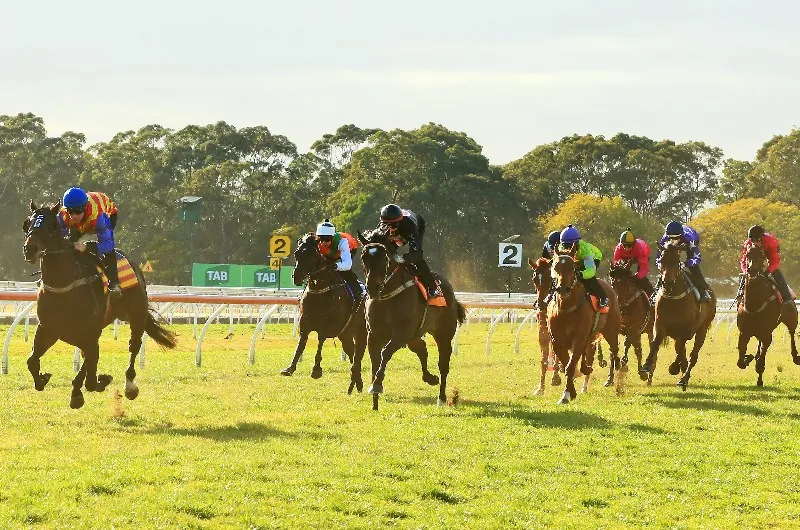
Racing Victoria stewards subsequently moved the rail from the seven-metre position to 11 metres between the 350-metre mark and the winning post, removing the disputed section from use.
The precaution allowed the entire Underwood Stakes program to proceed, but the MRC’s review has now strongly rejected the suggestion that the turf presented any danger to horses or riders.
“The jockeys clearly did not understand how turf plugs work,” MRC chief executive Tanya Fullarton said, according to Racenet.
“The jockeys’ claim that being able to pull the tops off the plugs somehow showed that the track was unsafe is nonsense.”

The club will nevertheless introduce an independent inspection process involving champion former jockey Damien Oliver before its remaining major spring meetings.
MRC Says Track Was Safe From the Beginning
The club’s review found the turf plugs had been installed correctly and did not create a safety risk.
Fullarton said the ability to lift the plugs manually did not demonstrate that they would move beneath a horse travelling at racing speed.
Turf plugs are regularly used to repair divots and damaged sections of a racing surface.
They can take at least two weeks to bind completely with the surrounding profile, meaning their tops may remain capable of being lifted during that period.
According to the MRC, that has been accepted track-maintenance practice for more than 25 years.
“Our review found no safety issue with the Caulfield racing surface,” Fullarton said.
“The turf plugs were correctly installed, the track as presented was safe for racing and the rail did not need to be moved.”
The club also pointed to dozens of similar plugs that remained in sections of the track used during the meeting without creating an incident.
That evidence supports the MRC’s technical position.
However, the fact racing proceeded safely does not conclusively prove the original section presented no potential risk.
Once the rail was moved, horses did not gallop over the exact area that had caused the greatest concern.
The remaining plugs may have been installed identically, but their successful performance cannot entirely reproduce what would have happened had a horse struck one of the disputed sections at full speed.
Jockeys Were Confronted by an Unfamiliar Visual Warning
The MRC may be correct about the technical function of turf plugs.
That does not mean the jockeys acted irresponsibly by raising the alarm.
Ben Melham, Mark Zahra and other riders inspected the surface after concerns emerged shortly before the opening race.
Television footage showed Melham and former champion jockey Darren Beadman lifting sizeable sections of turf with their hands.
To a rider preparing to travel at approximately 60km/h on a horse weighing more than 500kg, that was a confronting sight.
Jockeys are not turf-management specialists.
They are responsible for assessing whether a surface feels safe enough to race upon and immediately reporting anything that appears dangerous.
The potential consequences of remaining silent are far greater than the inconvenience caused by a precautionary rail movement.
A displaced section of turf can cause a horse to lose traction, particularly when cornering or accelerating under pressure.
Even if that risk was only perceived rather than real, expecting jockeys to ignore what they saw would establish a dangerous precedent.
The MRC’s explanation may prove the plugs were safe.
Its description of the riders’ concern as “nonsense” is unnecessarily dismissive of the people assuming the greatest physical risk.
Stewards Faced an Impossible Race-Morning Decision
Racing Victoria stewards received the concerns less than an hour before the first race.
They consequently had limited time to investigate the installation process, consult the track team and independently establish whether the plugs were capable of remaining stable beneath racing pressure.
Chief steward Rob Montgomery chose the cautious option.
The rail was moved an additional four metres through the home straight, preventing horses from using the disputed ground.
That decision briefly delayed the meeting but avoided a cancellation or prolonged postponement.
Fullarton said the stewards were placed in an extremely difficult position and were unable to properly consult the MRC’s track staff before issuing the direction.
“With the limited time available, they were unable to properly consult with our track team about the purpose, installation and condition of the plugs before making the incorrect decision to move the rail,” she said.
The criticism identifies the central failure without necessarily establishing that Montgomery’s decision was wrong.
The problem was not that jockeys reported the surface.
It was those concerns emerged so close to the beginning of a major meeting that stewards had no realistic opportunity to complete a detailed technical assessment.
Given the choice between accepting an uncertain risk and moving the rail, caution was inevitable.
Late Rail Change Altered the Meeting
Moving the rail from seven metres to 11 metres in the straight materially changed the shape of the track.
The usable racing surface became narrower and horses attempting to make ground from behind had less room to manoeuvre.
Patrick Moloney later described the altered course as “really awkward” because riders transitioned from the original rail placement into the temporary configuration approaching the straight.
Melham also acknowledged the change was not ideal for Angel Capital, a horse whose racing pattern requires space to build momentum from behind.
The inconvenience did not prevent him producing an exceptional afternoon.
Melham won the Group 1 Underwood Stakes aboard Birdman and later guided Angel Capital to victory in the Group 1 Sir Rupert Clarke Stakes.
Birdman’s victory completed an outstanding result for Chris Waller after the trainer chose to target the race with several leading middle-distance horses, including Buckaroo.
The Sporting Base had previously examined why Waller believed he had made the correct Underwood Stakes decision before the meeting.
Zahrann also won the Naturalism Stakes and emerged as a major Caulfield Cup contender.
The meeting therefore proceeded successfully from a racing perspective despite the unusual configuration.
That should not obscure the fact the late rail movement altered conditions after acceptances, barrier draws and race tactics had already been established.
Damien Oliver Will Provide an Independent View
The most constructive outcome is the appointment of Oliver to a new independent inspection role.
The retired champion will inspect racing surfaces with the relevant track manager on the day before major meetings.
Any concerns he identifies will be referred to Racing Victoria stewards, who can assess whether repairs or other changes are required before race morning.
The initiative will apply to the Manikato Stakes meeting, Caulfield Guineas Day and the Caulfield Cup carnival.
It will also extend to forthcoming feature meetings at Flemington and Sandown.
Oliver brings the practical knowledge of a jockey without being required to ride at the meeting.
That distinction should allow him to assess the surface objectively and communicate any concerns without the pressure created by an approaching race.
His involvement also gives current riders confidence that someone who understands their perspective has examined the track.
If Oliver confirms that turf plugs are properly installed and present no danger, jockeys should be more comfortable accepting that assessment.
If he identifies a legitimate concern, officials will have time to address it properly.
New Process Exposes the Original Communication Failure
The appointment of Oliver is sensible, but it also weakens the force of the MRC’s attack on the jockeys.
If the riders’ concerns were entirely baseless and the existing process was adequate, there would be little need for an additional independent inspection.
Introducing a new safeguard effectively acknowledges that the previous system failed to provide sufficient confidence.
The MRC knew turf plugs had been installed and understood that they could be manually lifted before binding with the surrounding grass.
The jockeys apparently did not.
That information should have been communicated before riders encountered the plugs during their inspection.
A simple explanation from the track team—supported by evidence about how the repairs respond under galloping pressure—may have prevented the entire dispute.
Instead, jockeys saw apparently loose turf, stewards received an urgent safety warning and a major rail alteration was ordered shortly before the first race.
The MRC may be correct that the surface was safe.
It cannot reasonably claim the broader process worked well.
Jockey Safety Concerns Must Never Be Discouraged
Racing has made significant progress in encouraging riders to report unsafe conditions.
That culture must be protected.
Jockeys should not fear public criticism whenever an investigation ultimately concludes that a perceived danger was technically safe.
They often make decisions with incomplete information while considering the possibility of catastrophic injury to themselves, their colleagues and the horses.
There is also an important difference between being incorrect and being unreasonable.
The MRC’s review may establish that the jockeys’ technical conclusion was incorrect.
Their concern was still reasonable based upon the information and visual evidence available to them.
Likewise, moving the rail may have proved unnecessary after a detailed review, but stewards did not possess the benefit of that review when they were forced to act.
The appropriate lesson is not that riders should remain silent.
It is that track repairs, inspection findings and technical explanations must be shared early enough for concerns to be properly assessed.
MRC’s Review Cannot Be the Final Word
The club’s findings deserve to be taken seriously because its track staff understand how the plugs were installed and how they were designed to behave.
However, an organisation reviewing its own work cannot provide the same reassurance as a genuinely independent investigation.
Racing Victoria should examine the incident, the placement of the plugs, the communication between officials and the decision-making process that produced the late rail change.
That does not require anyone to be punished.
It requires clear protocols before the spring’s biggest meetings.
Caulfield will soon host the Guineas and the $6.55 million Caulfield Cup, when scrutiny of the racing surface will be considerably greater.
The club cannot afford another major alteration shortly before the opening race.
Oliver’s appointment should help prevent that outcome.
His role can bridge the gap between specialist track staff and jockeys whose assessment is shaped by practical experience at racing speed.
Both Sides Can Be Right About Different Things
The evidence currently available supports the MRC’s conclusion that turf plugs can be correctly installed even when their tops remain capable of being lifted.
It also supports the jockeys’ decision to report a surface that appeared unsafe.
Those positions do not need to be treated as mutually exclusive.
The club understood the science and history behind the repair method.
The riders understood the consequences if the surface failed beneath them.
Stewards were left to make an urgent decision because the two perspectives had not been reconciled before race morning.
Caulfield ultimately raced safely and fairly, but the absence of an accident should not be used to ridicule legitimate concern.
The MRC has every right to defend its ground staff and correct inaccurate claims about their work.
It should do so without discouraging jockeys from speaking when they believe something may be wrong.
The new inspection system is the correct response.
It ensures the next safety debate can be resolved through evidence and communication before horses enter the mounting yard—not through a frantic rail movement while the first race approaches.