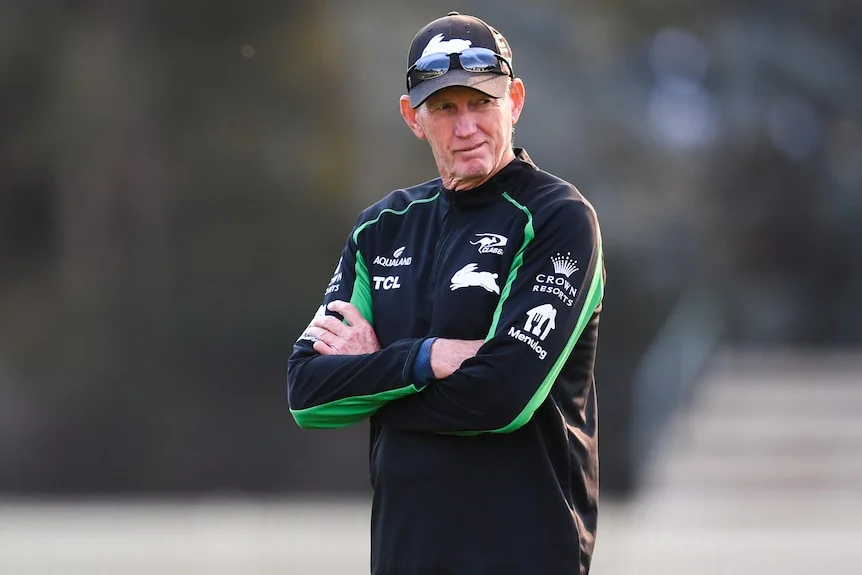
Wayne Bennett wants NRL teams to decide when the Bunker reviews tries as frustration surrounding video officiating reaches breaking point.
The South Sydney coach is reportedly preparing to present a challenge-based model to ARL Commission chairman Peter V’landys during the competition’s annual rules review.
Under Bennett’s proposal, the Bunker would no longer automatically examine every try-scoring play.
Instead, each team would receive an opportunity to request a video review when it believed the referee had made an incorrect decision.
A successful challenge would allow the team to retain its review. An unsuccessful challenge would prevent it from using the Bunker again during the match.
“I want to know who’s refereeing the game,” Bennett said after South Sydney’s controversial elimination-final defeat to Newcastle.

“Is it the referee or the Bunker?”
Bennett Wants Teams to Control Reviews
Bennett’s preferred option remains removing the Bunker entirely and returning control to the on-field referee.
However, the challenge system represents a compromise that could reduce video intervention without abandoning technology altogether.
According to News Corp, Bennett intends to discuss the proposal with the NRL after the season.
The system would operate similarly to the existing captain’s challenge but apply specifically to try-scoring situations.
Teams would need to identify a potential error and decide whether the incident was significant enough to risk their access to the Bunker for the remainder of the match.
That would place greater responsibility upon players, captains and coaching boxes.
It could also prevent lengthy examinations of incidents neither team seriously disputes.
Bennett’s broader argument is that the Bunker has shifted authority away from the referee without delivering the certainty required to justify that change.
“The quicker they get rid of the Bunker, the happier I’ll be,” he said following South Sydney’s finals exit.
Rabbitohs Defeat Became Bennett’s Breaking Point
Bennett’s latest push follows South Sydney’s 20-10 elimination-final loss to Newcastle.
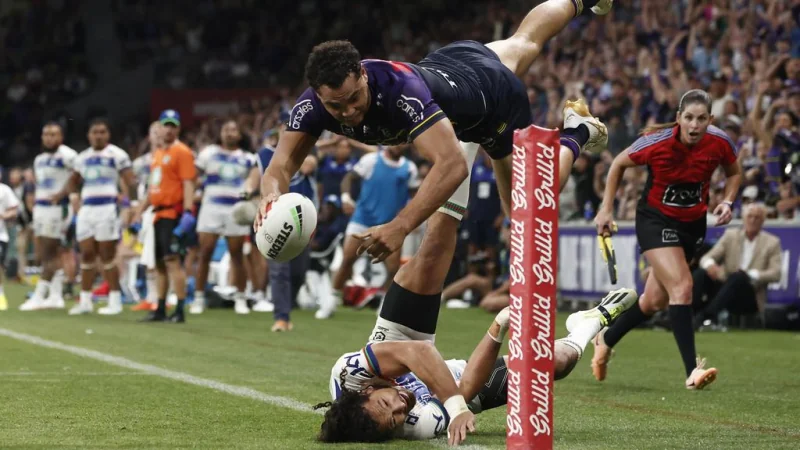
The Rabbitohs appeared to have levelled the match when Jayden Sullivan scored after Alex Johnston lost possession under pressure from Jermaine McEwen.
Referee Ashley Klein ruled McEwen had stripped the ball and awarded the try.
Bunker official Chris Butler overturned that decision, determining Johnston had lost possession because McEwen contacted his arm rather than deliberately playing at the football.
Approximately 10 minutes later, Dominic Young scored for Newcastle despite replays creating doubt over whether the winger had remained inside the field of play.
The Bunker allowed Klein’s try decision to stand because there was insufficient evidence to overturn it.
Bennett was frustrated by what he regarded as two different standards.
The first close decision resulted in the referee being overruled. The second returned to the on-field decision because the video evidence was inconclusive.
“You can look at that 50 times, everyone can come with a different opinion on that,” Bennett said.
“It’s just too technical.”
The NRL subsequently supported both decisions, but that did little to address Bennett’s fundamental concern.
His argument was not simply that South Sydney had received an incorrect ruling.
It was that the Bunker was being treated as an authoritative solution while continuing to produce subjective decisions.
Warriors Controversy Intensified the Debate
The debate became even more complicated during Newcastle’s 12-10 semi-final victory over the Warriors at Eden Park.
Klein failed to penalise Tyson Frizell after the Knights forward moved into Leka Halasima’s path as the Warriors chased a kick during the final minute.
A penalty would have given New Zealand an opportunity to level the match from almost directly in front.
The NRL later accepted that Klein should have penalised Frizell, leading to the experienced official being overlooked for an on-field preliminary-final appointment.
However, the Bunker was unable to intervene because the incident occurred during general play and did not produce a try-scoring decision or another reviewable stoppage.
The episode captured the impossible position surrounding video officiating.
Bennett and other critics believe the Bunker intervenes too frequently.
Warriors supporters were furious because it could not intervene when an obvious error threatened to end their season.
Expanding the Bunker’s authority would theoretically prevent similar missed penalties.
It would also create more stoppages and potentially allow video officials to search backwards through ordinary passages of play.
Bennett’s Proposal Would Not Have Saved the Warriors
The greatest weakness in Bennett’s model is that it would not necessarily have corrected the Frizell decision.
His reported proposal applies to try-scoring plays.
Halasima did not score, Klein did not stop play and the Warriors had no try decision to challenge.
Even if New Zealand retained access to Bennett’s proposed Bunker review, officials would need to define when a team could activate it and how far the video official could examine an earlier incident.
Allowing teams to stop play and challenge any suspected penalty would create obvious tactical problems.
A defending side could use a review to interrupt an opponent’s momentum. A team under pressure could manufacture a stoppage while searching for minor illegal contact.
Restricting reviews to natural stoppages would avoid that problem but leave some decisive non-calls beyond correction.
Bennett’s system could reduce unnecessary involvement in try decisions.
It cannot remove controversy from every part of the match.
Challenge Model Would Restore Referee Authority
The proposal nevertheless has genuine merit.
Automatic reviews encourage the expectation that every try will be examined until officials discover a reason to disallow it.
That process can drain excitement from the moment and leave supporters waiting for confirmation before celebrating.
A challenge model would restore the presumption that the referee’s decision stands unless one team identifies a clear problem.
It would also force captains to use reviews strategically.
A team that challenged a marginal obstruction during the opening 10 minutes and failed could be left without video assistance when a more significant decision arrived late in the match.
That risk may discourage speculative challenges and allow the game to flow more naturally.
However, it could also produce a deeply unsatisfactory outcome if an obvious error remained uncorrected simply because a team had unsuccessfully challenged an earlier decision.
The NRL would also need to decide whether challenges belonged to the captain, coach or both.
NRL captains may not have seen the most revealing replay before deciding whether to challenge, while allowing coaches to intervene could create delays as messages travel from the box to the field.
Technology Cannot Eliminate Subjective Decisions
Bennett has repeatedly said he can accept mistakes from referees and players.
What he cannot accept is a system promoted as the solution to human error making its own mistakes while weakening the referee’s control.
That criticism is understandable, but no version of video officiating can deliver complete certainty.
Obstructions, strips and escort plays frequently require judgement about intention, positioning and the effect of contact.
More camera angles do not automatically make those decisions objective.
Removing the Bunker would produce quicker matches and clearer authority.
It would also guarantee that some visible errors remained uncorrected despite millions of viewers immediately seeing them on television.
The challenge is therefore not choosing between perfection and imperfection.
It is deciding which type of imperfection rugby league is prepared to tolerate.
Bennett prefers mistakes made by the referee in real time.
The NRL has generally preferred additional scrutiny, even when that scrutiny slows the game and creates new arguments.
His proposed challenge system offers a middle position.
It would preserve video assistance for major disputed tries while ensuring the Bunker became a tool used by teams rather than a constant second referee.
Whether it could survive the pressure of a finals match may depend upon the details Bennett presents to V’landys.