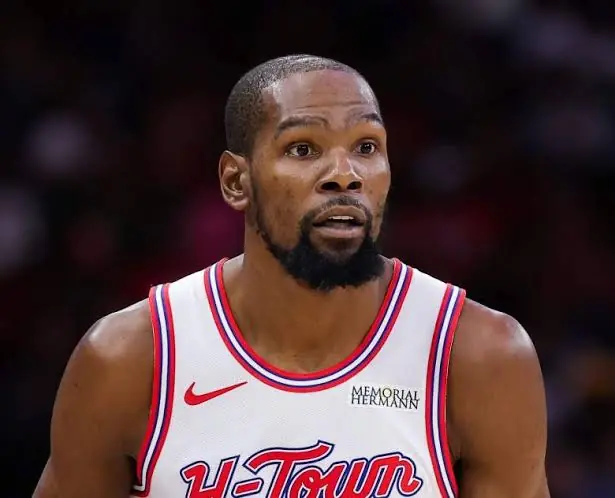
Kevin Durant could reportedly return only one first-round pick if the Houston Rockets decide to abandon their championship gamble and trade the 38-year-old superstar near the February deadline.
Houston acquired Durant from Phoenix last year in exchange for Jalen Green, Dillon Brooks, the rights to No.10 draft pick Khaman Maluach and five second-round selections.
That substantial package reflected the belief that one of the greatest scorers in NBA history could become the final piece required to transform Houston’s emerging roster into a championship team.
However, an unnamed NBA executive claims the Rockets would recover significantly less if they attempted to move Durant now.
“They could get a first-round pick for him, probably,” the executive told Heavy Sports.

“Not a lot more, though, not like what Phoenix got. He’s not just a guy who gives you 26 points, all the other stuff makes it more complicated with him.”
That assessment does not mean Houston is currently shopping Durant or has decided to trade him.
The Rockets can enter the season with their veteran scorer and determine whether the return of Fred VanVleet allows the roster to function more effectively.
But if the partnership begins poorly, Houston may face an uncomfortable choice between continuing with an expensive experiment or accepting a dramatically reduced return.
Durant Remains One of the NBA’s Best Scorers
Any suggestion Durant has become an ordinary player would be ridiculous.
Even as he approaches his 38th birthday, the two-time NBA Finals MVP remains capable of producing approximately 26 points per game with exceptional efficiency.
His height, shooting touch and high release point make him almost impossible to defend individually.
Durant can score from three-point range, attack mismatches from the middle of the floor and create efficient offence late in the shot clock when a possession has broken down.
That skill set remains extremely valuable during the playoffs.
Defences become more organised, transition opportunities disappear and teams increasingly require players who can create high-quality shots without relying upon a complicated system.
Durant continues to provide that ability.
The problem is not whether he can score.
It is whether another contender would surrender premium assets for his age, contract, injury risk and the wider concerns referenced by rival executives.
Houston’s Leadership Gamble Has Not Worked Yet
The Rockets did not acquire Durant merely to add another scorer.
They wanted an experienced champion capable of helping a talented young roster navigate the most demanding stages of a championship campaign.
Heavy’s report suggests league executives remain concerned about whether Durant can consistently provide that form of leadership.
The criticism should be treated as one unnamed executive’s assessment rather than an established fact.
Durant has been an important member of championship teams and possesses more high-level postseason experience than almost every player Houston could realistically acquire.
However, his previous stops have often ended with tension or disappointment.
Durant left Golden State after three seasons despite winning two championships and two Finals MVP awards.
His partnership with Kyrie Irving in Brooklyn failed to produce sustained playoff success, while Phoenix dismantled its expensive superstar roster after falling well short of expectations.
Reports of controversy in Houston have now added another layer of uncertainty.
Interested teams would not be acquiring only Durant’s scoring.
They would also need to determine how he would affect an established hierarchy, coaching structure and dressing-room culture.
Phoenix May Have Won the Original Trade
The Suns’ return for Durant looks increasingly impressive.
Green struggled to fit immediately in Phoenix and regressed during his first season with the organisation, but he remains young enough to recover his value or become an important trade asset.
Brooks provided Phoenix with an established defender and competitive veteran capable of guarding difficult perimeter matchups.
Maluach endured a challenging rookie season after being selected with the No.10 pick, although the 19-year-old was always expected to require development.
Phoenix also received five second-round selections.
None of those assets individually approaches Durant’s ability.
Together, they gave the Suns youth, defensive help and considerably greater flexibility after years spent constructing an expensive veteran roster.
Houston accepted that price because it believed Durant could deliver a championship—not because it expected to recover equivalent value later.
If the Rockets move him for one first-round pick, the original deal will appear even more favourable for Phoenix.
That does not automatically make Houston’s decision a mistake.
Championship contenders are sometimes required to sacrifice future value for a genuine opportunity to win immediately.
The trade becomes a failure only if Durant does not move the Rockets significantly closer to a title.
Rockets Can Afford to Wait
Houston has no reason to force a trade before seeing how the new season develops.
VanVleet’s return from a torn ACL should restore an experienced organiser capable of controlling the offence and reducing the playmaking burden placed upon Durant.
That could allow the veteran forward to concentrate upon what he still does extraordinarily well.
Durant does not need to become the loudest leader in the dressing room if VanVleet, coach Ime Udoka and Houston’s other veterans can establish the team’s standards.
He needs to score efficiently, compete defensively and remain healthy for the postseason.
Houston also possesses a talented younger core featuring Amen Thompson, Alperen Şengün and Jabari Smith Jr.
If those players continue developing, Durant may not need to dominate every night for the Rockets to become a serious Western Conference threat.
A strong beginning would eliminate much of the current speculation.
A poor start would intensify it.
By January, Houston should understand whether Durant remains the final piece of its championship roster or an aging asset whose value will continue falling.
Contenders Will Still Call
One first-round pick may sound like an underwhelming return for Durant.
It could still attract several teams.
Miami has already been connected with a hypothetical package containing Andrew Wiggins, Nikola Jović and a 2029 first-round selection.
That proposal has not been reported as an active negotiation, but it demonstrates the type of framework contenders may consider if Houston opens the door.
Durant would give Miami another elite scorer alongside Giannis Antetokounmpo and Bam Adebayo, although the Heat would need to decide whether adding another expensive veteran was worth surrendering one of their remaining young assets.
Cleveland has also been linked with a complicated multi-team proposal that would place Durant beside Donovan Mitchell and Evan Mobley.
The Sporting Base previously examined why a Durant trade to Cleveland would create a terrifying team but face enormous practical obstacles.
Golden State represents the most emotional possibility.
The Warriors have reportedly kept the door open for a Durant reunion with Stephen Curry, although Durant rejected the chance to return before the 2025 trade deadline.
None of those teams should be considered a confirmed bidder.
They merely illustrate that Houston would have options if Durant became available.
One First-Round Pick May Be Misleading
The value of a first-round selection varies enormously.
A heavily protected pick from an established contender could fall late in the draft and carry limited upside.
An unprotected selection several years into the future could become the most valuable asset in a major trade.
Houston should therefore care more about the quality and timing of the pick than whether a team offers one or two selections.
The Rockets must also assess the players included for salary-matching purposes.
An expiring contract could create valuable financial flexibility.
An unwanted veteran signed for several seasons could make a one-pick package considerably less appealing.
Houston is not required to reproduce the exact return Phoenix received.
It needs to secure a package that either helps the current roster or strengthens the franchise beyond Durant’s remaining career.
Accepting an ordinary pick alongside undesirable salary simply to end the relationship would be poor asset management.
Durant Controls Part of the Market
Durant’s preferences would also influence any potential trade.
Contenders are unlikely to surrender serious assets for a player who does not want to join them, particularly given his age and history of changing teams.
A narrow list of acceptable destinations would reduce Houston’s leverage.
That became evident before Phoenix traded Durant to the Rockets, when his preferred destinations helped shape the eventual market.
Durant does not possess complete contractual control over a trade, but his influence remains considerable.
A team acquiring him would want confidence that he was committed to its championship project.
Houston may receive only one premium offer if other interested organisations believe Durant would resist their approach.
That could make the market even more “complicated” than the unnamed executive suggested.
Rockets Must Judge Durant by Championships
Durant’s future should not be decided by his regular-season scoring average.
Nobody seriously doubts that he can continue producing points.
Houston acquired him to change what happens in May and June.
If the Rockets enter the season strongly and Durant helps their younger stars handle playoff pressure, the original price will become irrelevant.
A genuine championship run would justify the deal even if Houston eventually lost him for nothing.
If the team remains outside the leading group in the Western Conference, the front office must resist allowing reputation to dictate its decision.
Durant’s trade value will not increase as he moves further beyond his 38th birthday.
The Rockets may have only one realistic opportunity to recover a first-round pick before age and contract uncertainty reduce the market again.
For now, Houston can continue chasing the outcome it originally purchased.
If that chase begins collapsing, one first-round pick may become the best escape available.
It may be the perfect plan.
Unfortunately for the Warriors, it depends upon Phoenix making the one decision it has repeatedly promised never to make.